- AI verticals
Intelligence built into your products and operations. Consulting, custom models, agents, and copilots designed around how your business actually runs.

The AI-native system behind every project.
Get AI ConsultationAI Services
Generative AI Services
Machine Learning Services
Company
- Industries
Comprehensive App & Software Development across 20+ industries
Awards & Recognitions

 All IndustriesTrusted and Recognized by


- From fast-moving startups to Fortune 500 enterprises.
A future-focused tech partner building, shipping, and scaling products for some of the world's most demanding companies.
View All Case Studies













How We Replaced Paperwork and Phone Tag with One Platform Where Customers File, Pay, and Learn Online
Gifted Financial Services' Digital Financial Services Platform
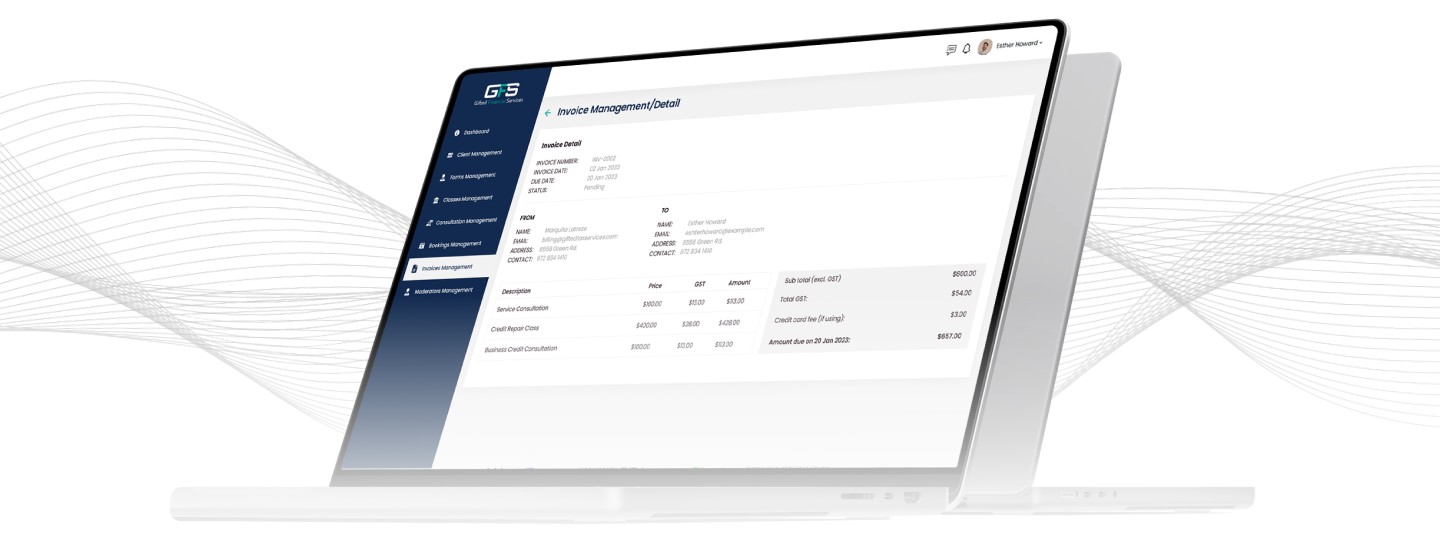
Gifted Financial Services helps US customers with tax filing, credit repair, loans and insurance, audit assistance, and payroll. The work ran on paper and physical visits, so every service meant ad-hoc back-and-forth and costs that climbed with the inefficiency. We built a platform where the owner designs a custom form for any service, publishes it to the customer portal, and runs the whole job online, drafts saved in one place, payment taken in-system, moderators assigned per case, and paid financial-literacy classes built in. Physical paperwork became an online workflow.
The Impact
A Financial Services Provider Running on Paper and In-Person Visits
Gifted Financial Services is a US-based provider working with customers nationwide. They handle tax filing, credit repair, loans and insurance, audit assistance, and payroll.
They also wanted to teach. Part of the vision was a financial-literacy mode — paid consultations and classes, both live and pre-recorded, run by the owner.
They came to us to take a physical, manual operation online and build something that could grow with new services over time.
Every Service Meant Paperwork, Visits, and Back-and-Forth
Getting a service done required manual paperwork and physical intervention. A customer and the team traded documents and calls ad hoc, with no single place to manage a case.
Take tax filing. A customer had to gather documents and send files to a filing agent, with the information scattered across the exchange and no unified record.
The inefficiency had a price. Manual handling made services slower to deliver and pushed their cost up.
Three roles all worked around the same gaps: customers, the owner running everything as super admin, and moderators who needed to oversee cases but had no system to do it in.

We Built a Form Builder, So New Services Wouldn't Need New Code
The client offers several services, and they’ll add more. Fixed, inbuilt forms would have meant a build cycle every time a service changed. We gave them a dynamic form builder instead: the admin designs a form for any service, publishes it to the customer portal, and customers fill and save it as a draft so their data stays in one place. Template management sits alongside it for reuse.
We split the build across three surfaces for clear reasons. The customer-facing website runs on Next.js for stronger SEO and crawlability, since this is where new customers find the business. The admin and client portals run on React, where component flexibility let us build custom logic and a sleek interface that scales. The backend is Node.js and NestJS on PostgreSQL.
A few decisions came from pushing back on the original task.
The client wanted SMS alerts for action-required steps like tax filing. SMS would have driven recurring cost up, so we used email and system notifications instead, and added a banner that stays in the system until the user acts. The action can’t be missed, and there’s no per-message bill.
Payments needed care. Stripe wouldn’t accept the business framing, so we moved to an alternative gateway and added encryption software to handle payment securely.
For classes, the client wanted calls built into the software. Hosting live video ourselves would have added cost and complexity, so we kept bookings and scheduling in-platform and let the actual calls run on Zoom or Meet.
One Platform, Three Roles, Built to Add Services
A Four-Person Build, Run Close to the Client
A team of four delivered the platform from scratch starting in 2024, one developer, one business analyst, one PM, and one QA. The build began as custom software development.
The business analyst carried the engagement from pre-sales into delivery. After the proposal, SOW, and kickoff, that BA verified workflows and designs directly with the client, so the requirements that shaped the build came from the people who run the business.
Collaboration leaned heavily on the client’s own knowledge of their services and customers, which set the workflows the platform had to support.
Following the standing policy, here’s an unattributed testimonial draft with a pending-approval tag (no real client quote was provided, so this shouldn’t be published until confirmed with the client).
The Whole Operation Now Runs Online
Services that depended on paper and in-person visits now run end to end in the platform. A customer picks a service, fills a form built for it, and saves drafts as they go, pays in-system, and stays in touch with their moderator over chat.
The owner manages all of it as super admin, builds new service forms without waiting on a release, and assigns moderators per case. The financial-literacy classes give the business a second line of engagement, with bookings handled in-platform.
Moving online widened the client’s reach beyond in-person customers and grew their customer count. The platform is built to keep going: the client is weighing a subscription product model, and the roadmap points toward IRS auto e-filing, where a completed form files itself.
Testimonials
"Our entire business used to run on paperwork and in-person visits, and every service meant chasing documents and phone calls. AppVerticals built us a platform where I can design a form for any service, publish it myself, and run the whole job online without waiting on a developer. Payments, drafts, moderators, and even our classes all live in one place now. It let us reach customers well beyond our local area and grow the business in a way paper never could."

Paper-Heavy Operations, Rebuilt to Scale
If you're moving a manual, paper-heavy service business online and need it to keep adding services without a rebuild each time, that's the kind of platform we build.
Start a conversation